Serving The Wasatch Front Area



Back to Blog
AC Repair vs Replacement Costs: Guide for Ogden Homeowners
June 29, 2026
When you’re experiencing issues with your air conditioner, the last thing you want to think about is the cost of fixing it. That’s why this AC Repair vs. Replacement cost guide for Ogden homeowners starts with a question that usually shows up at the worst possible time: Should you pay for the repair, or is it smarter to put that money toward a new AC system?
It’s not always an easy call. A small repair on a newer AC can feel simple enough. A major repair on an older system, though? That’s when your brain starts doing math while your house keeps getting warmer.
Comfort Solutions helps Ogden homeowners compare both options clearly, so you’re not stuck guessing, panic-buying, or throwing money at a system that may already be close to retirement. In this guide, we’ll walk through repair costs, replacement costs, system age, refrigerant type, energy bills, rebates, and the signs that tell you which choice makes more financial sense.
Key Takeaways
- AC repair is usually the better choice when the system is under 10 years old, the issue is minor, and the unit hasn’t needed repeated service.
- AC replacement is worth comparing when the repair costs 30% to 50% of a new system, especially if the AC is already 10 to 15 years old.
- Expensive repairs, such as compressor, evaporator coil, or refrigerant leak repairs, can quickly make replacement the smarter long-term option.
- R-22 refrigerant can make repair costs harder to justify because new R-22 production and import ended in the U.S. in 2020.
- Federal HVAC tax credits should not be assumed for new 2026 installations, but Utah utility rebates may still help reduce replacement costs.
- The best decision comes from comparing both numbers: what it costs to repair the AC now and what it costs to replace it before another major breakdown.
AC Repair vs. Replacement at a Glance
Still stuck between repair and replacement? Here’s the quick version before we get into the full cost breakdown.
| Cost Factor | AC Repair Makes More Sense When | AC Replacement Makes More Sense When |
| System age | Your AC is under 10 years old | Your AC is 12 to 15+ years old |
| Repair cost | The repair is minor and affordable | The repair costs 30% to 50% of a new system |
| Repair history | This is the first major issue | You’ve had repeated repairs in recent summers |
| Refrigerant type | The system uses newer refrigerant | The system uses R-22 and has a refrigerant leak |
| Energy bills | Bills are still steady | Bills keep rising even with normal usage |
| Cooling performance | The AC still cools your home evenly | Rooms stay hot, the system runs constantly, or comfort problems keep coming back |
| Long-term value | The repair can buy several more reliable years | Replacement may prevent paying for another major repair soon |
How Much Does AC Repair Cost in Ogden?
AC repair or HVAC repair costs depend on several factors, including what caused the issue, how old the system is, and whether parts are still under warranty. That’s why one repair can cost a few hundred dollars while another can jump into the thousands.
Here’s a practical repair cost guide to help you sort the smaller fixes from the bigger warning signs:
| AC Repair Type | Typical Cost Range | Repair or Replacement? |
|---|---|---|
| Capacitor or contactor replacement | $150 to $600 | Usually repair |
| Thermostat or electrical repair | $150 to $650 | Usually repair |
| Condensate drain or pump repair | $250 to $500 | Usually repair |
| Fan motor replacement | $400 to $1,400 | Depends on system age |
| Refrigerant leak repair and recharge | $600 to $1,500+ | Compare repair and replacement |
| Evaporator coil replacement | $1,000 to $4,500+ | Compare repair and replacement |
| Compressor replacement | $900 to $3,500+ | Often replace if older |
| Full AC replacement | $5,000 to $12,500+ | Depends on system size and efficiency |
So, what does this mean?
If your AC needs a new capacitor, repair usually makes sense. If it needs a compressor and the system is already 14 years old, replacement deserves a real conversation.
This is where Comfort Solutions can help you avoid the guesswork. Our certified technicians start with a professional diagnosis to confirm what’s actually wrong before comparing repair against replacement. They handle common AC repairs like refrigerant leak detection, compressor issues, electrical component repairs, fan motor replacement, and condensate drain cleaning. If your system can be repaired for a reasonable cost, we’ll walk you through that option before you spend more than needed.
How Much Does an AC Replacement Cost in Ogden?
An AC replacement costs more upfront than repair, but it also resets the system’s life, warranty, efficiency, and reliability; new air conditioning system installations commonly include about a 10-year warranty, which can make replacement the more cost-effective solution over time.
For many homes, central air conditioner replacement costs about $5,800 to $17,000. Replacing an entire air conditioning system can reach around $16,500 depending on scope, equipment, and installation complexity. The final price depends on:
- System size: Larger homes usually need more cooling capacity.
- Efficiency rating: Higher-efficiency systems cost more upfront but may lower monthly energy use.
- Equipment type: Single-stage, two-stage, variable-speed, and heat pump systems carry different price points.
- Ductwork condition: Damaged, undersized, or leaky ducts can raise the project cost.
- Installation complexity: Electrical updates, access issues, and code requirements can affect the quote.
- Warranty coverage: Better coverage can change the long-term value of replacement.
That’s why replacement shouldn’t be judged by sticker price alone. A cheaper system installed poorly can create repair problems later. A properly sized system installed well can give your home steadier cooling, better energy performance, and fewer surprise repair calls.
If your repair quote is already high, Comfort Solutions can help you compare that repair against an AC upgrade or replacement estimate. As the largest Trane Comfort Specialist in the Rocky Mountain Region, we work with homeowners who want equipment options that fit Utah’s heat, dry air, and seasonal temperature swings, and we offer the same clear-eyed approach for furnace repair and replacement service when winter costs come into question. You’ll get a clearer look at repair cost, replacement cost, system performance, and available options before making the call.
Get My AC Replacement Estimate
When Is AC Repair Cheaper Than Replacement?
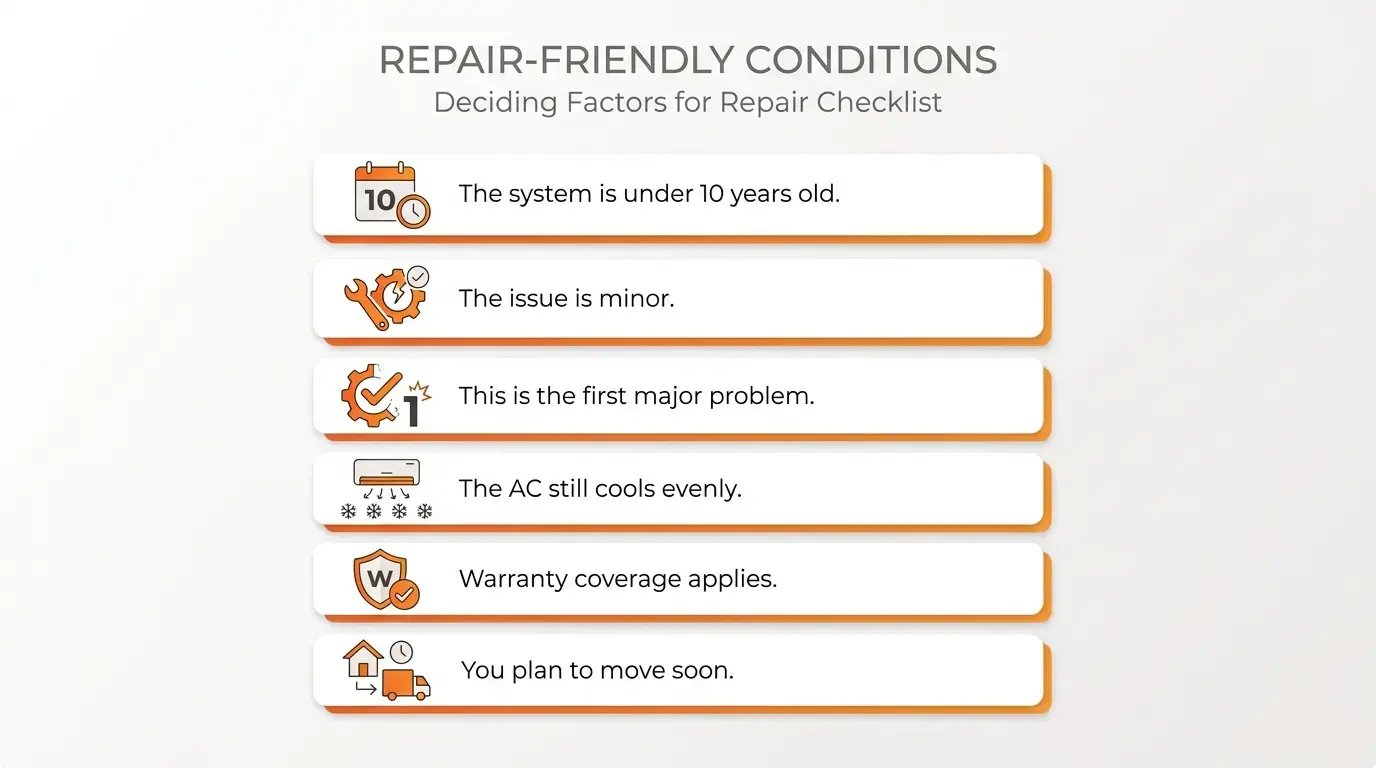
AC repair is cheaper than replacement when the repair is small, isolated, and unlikely to lead to another big bill soon.
Repair usually makes sense when:
- The system is under 10 years old: A younger AC often has useful life left, and well-maintained HVAC systems typically last about 10 to 15 years.
- The issue is minor: Capacitors, contactors, thermostats, and clogged drains are usually manageable repairs.
- This is the first major problem: One repair does not automatically mean your system is failing. Not every problem points to full system replacement.
- The AC still cools evenly: Good performance after repair is a strong reason to keep it.
- Warranty coverage applies: Covered parts can make repair much more affordable.
- You plan to move soon: Replacement may not pay off if you won’t own the home long enough to benefit.
Here’s the key: Repair is a smart choice when it buys you meaningful time at a reasonable cost.
For example, paying $300 to fix a five-year-old AC is usually worth it. You’re not throwing money away; you’re protecting a system that still has years left.
When Is AC Replacement Worth the Higher Upfront Cost?
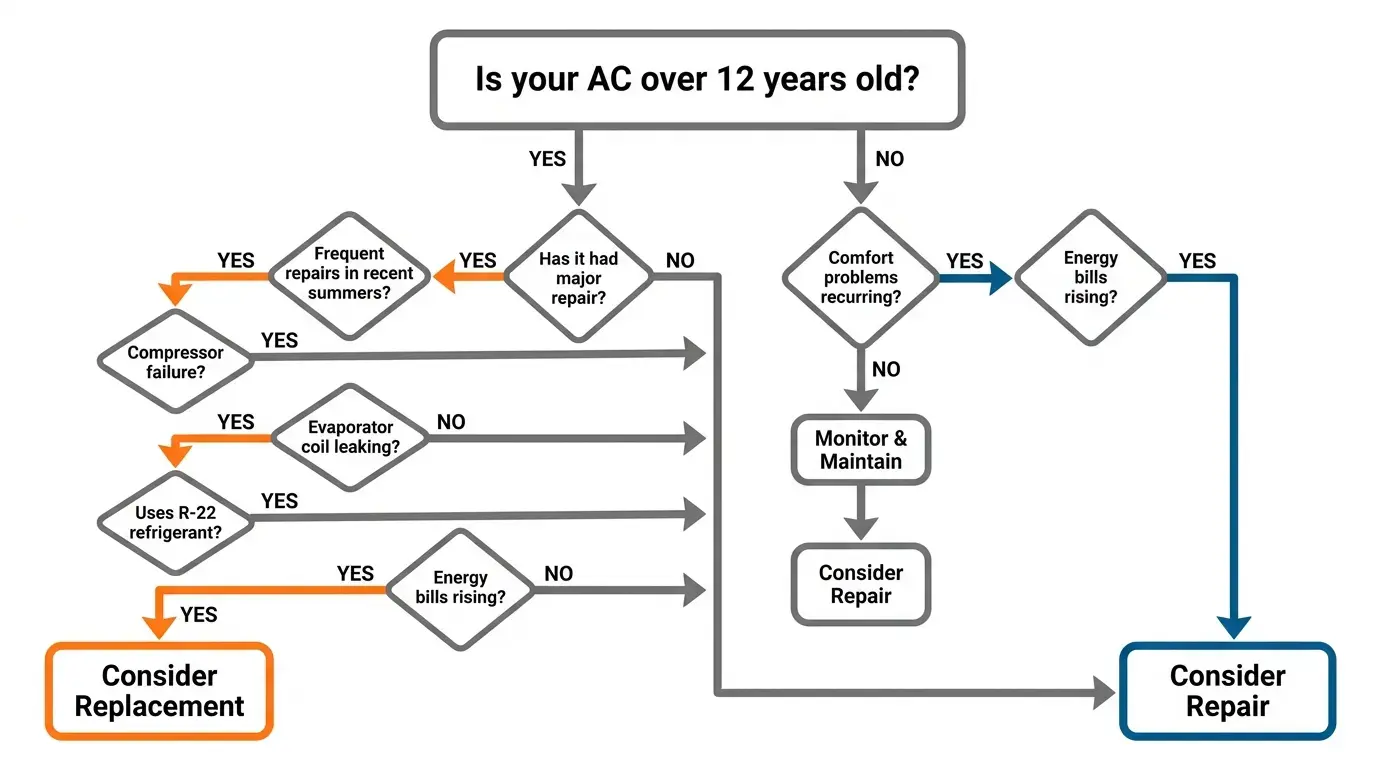
Replacement starts to make more sense when repairs become expensive, repetitive, or too close to the cost of a new system.
You should compare replacement options when:
- Your AC is over 12 years old and needs a major repair: The system may not have enough life left to justify the cost.
- You’ve had frequent repairs in recent summers: A pattern of breakdowns usually means more bills are coming.
- The compressor has failed: Compressor replacement is one of the most expensive AC repairs.
- The evaporator coil is leaking: Coil repairs can be costly, especially without warranty coverage.
- The system uses R-22 refrigerant: Older refrigerant can make leak repairs more expensive.
- Energy bills keep rising: The system may be working harder to deliver weaker cooling, while a new AC unit may cut energy costs by roughly 30% to 40%, and modern high-efficiency air conditioning units often reduce energy consumption by about 20% to 40%.
- Comfort problems keep returning: Uneven rooms, short cycling, and constant running can point to deeper system issues.
To put it simply, repairs buy time. A new unit buys a reset in reliability and efficiency.
If the system still has good years left, buying time can be smart. If it’s already draining your budget, a reset may cost less over the next several summers.
What Is the 50% Rule for AC Repair vs. Replacement?
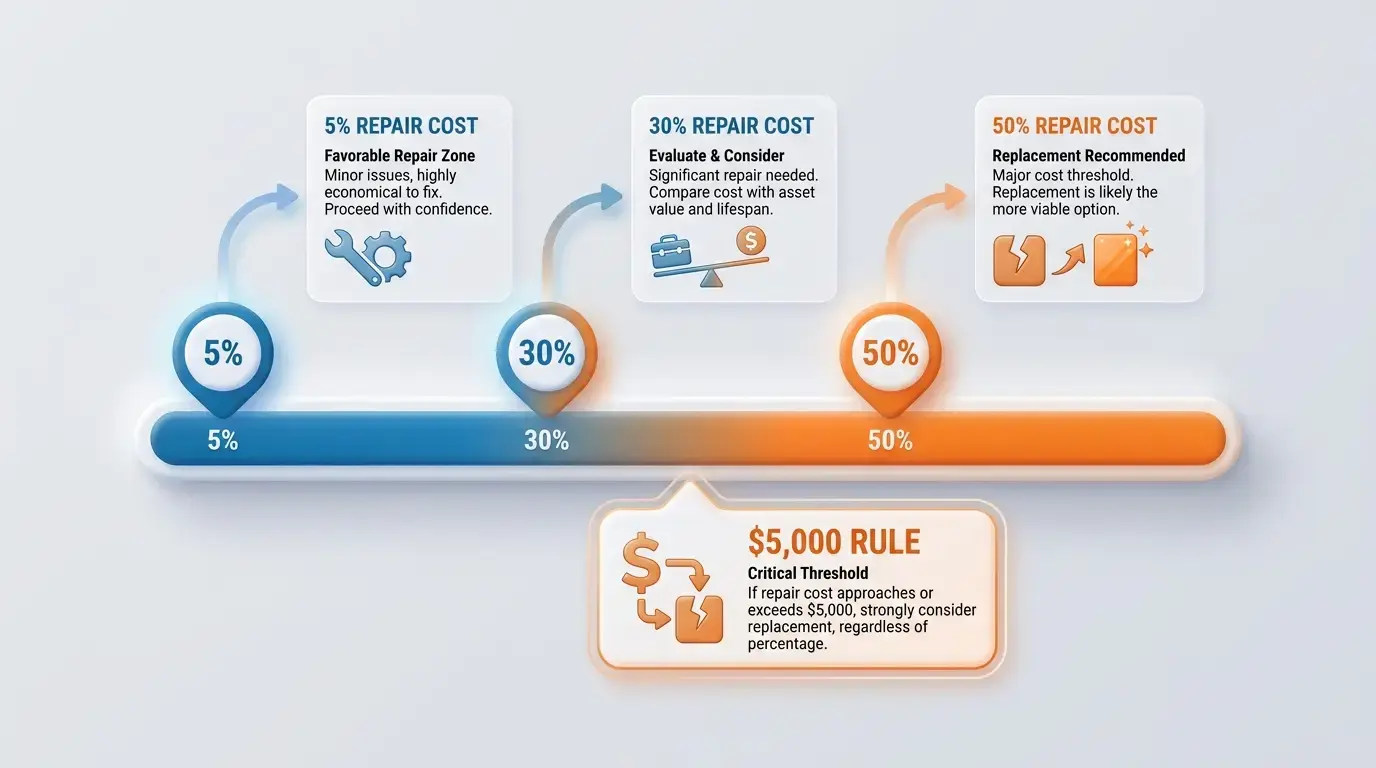
The 50% rule is a quick way to test whether a repair is still worth it.
Here’s how it works: If the repair costs around 50% of the price of a new AC system, replacement usually deserves serious consideration.
Another shortcut some homeowners use is the $5,000 rule: multiply the unit’s age by the repair estimate, and if the total is above $5,000, HVAC replacement usually deserves serious consideration because it helps you judge whether the current system is still worth funding. Homeowners weighing a similar furnace tune-up cost decision can use the same logic to judge whether ongoing upkeep still makes sense.
Let’s say a new system would cost $8,000.
A $400 repair is only 5% of replacement cost. In most cases, repairing makes sense.
A $2,500 repair is more than 30% of replacement cost. At that point, you should compare repair and replacement side by side.
A $4,000 repair is 50% of replacement cost. That’s when the conversation changes. You’re no longer just fixing a part; you’re deciding whether the whole system is still worth funding.
This rule isn’t perfect, but it’s useful. It keeps you from spending thousands on an AC that may still need to be replaced soon anyway.
How Does AC Age Affect Repair vs. Replacement Cost?
Age matters because every repair has to be weighed against how much life the system likely has left, and the decision depends on age because older systems usually have less remaining life and lower efficiency.
A six-year-old AC with one failed part is usually a repair situation. A 16-year-old AC with a major failure is usually a replacement conversation.
Use this quick guide:
| AC Age | What Usually Makes Sense |
|---|---|
| Under 8 years | Repair usually wins unless the failure is major |
| 8 to 12 years | Compare repair cost, warranty, and repair history |
| 12 to 15 years | Replacement becomes more likely for major repairs |
| 15+ years | Replacement often makes more financial sense |
| 20+ years | Replacement is usually the safer long-term plan |
An HVAC system often lasts 10 to 15 years with proper maintenance, though some HVAC units may reach 20 years depending on conditions and upkeep.
Still, age is only one piece of the decision.
A well-maintained 12-year-old AC with proper maintenance may still be worth repairing. A neglected nine-year-old AC with multiple breakdowns may already be on the replacement path.
That’s why Comfort Solutions looks at the full system, not just the date on the equipment label.
Which AC Repairs Are Usually Worth Paying For?
Some AC repairs are normal wear-and-tear issues. They’re annoying, yes, but they don’t always mean the system is done.
Repairs that are usually worth paying for include:
- Capacitor replacement: A common repair that can restore startup power.
- Contactor replacement: A smaller electrical repair that helps the outdoor unit engage properly.
- Thermostat replacement: Often worth fixing if the AC itself is still healthy.
- Condensate drain cleaning: A practical repair when water backup or drainage is the issue.
- Minor electrical repairs: Usually worth it on a newer or otherwise reliable AC.
- Small fan motor repairs: Often reasonable if the system is still under 10 years old.
These repairs are usually small enough that a replacement would be overkill.
However, context still matters. If the same system has needed several “small” repairs in a short period, those small bills can start telling a bigger story.
Which AC Repairs Usually Mean It’s Time to Replace?
Some repairs are expensive enough that you should pause before approving them.
Replacement may be the better option when the repair involves:
- Compressor failure: The compressor is the heart of the AC, and replacement can be expensive.
- Evaporator coil failure: Coil replacement can cost enough to make an older system hard to justify.
- Major refrigerant leaks: Leak detection, repair work, and recharge costs can add up quickly.
- Repeated electrical failures: Multiple failures may point to age, overheating, or deeper system strain.
- Major repairs on an R-22 system: The refrigerant issue can make future repairs even more expensive.
- Repeated service calls over the last few years: If you’re calling for repairs every season, the system may already be declining.
Not every repair on older units means replacement, but a major failure plus a pattern of repairs usually does.
This is where the repair vs. replacement question becomes less about today’s bill and more about the next 3 to 5 years.
If you repair it now, how likely is another major repair soon? If the answer is “pretty likely,” replacement may be the cleaner financial move.
How Does R-22 Refrigerant Affect AC Repair Costs?
R-22 refrigerant can make an older AC more expensive to repair.
New R-22 production and import ended in the U.S. in 2020. Existing systems can still be serviced, but the supply depends on recovered, recycled, reclaimed, or stockpiled refrigerant.
That matters because a refrigerant leak isn’t just a quick refill.
A proper repair may involve:
- Finding the leak
- Repairing the damaged area
- Testing the system
- Recharging the refrigerant
- Checking performance after the repair
If the system is old and uses R-22, that cost can climb fast. Even worse, topping off refrigerant without fixing the leak only delays the same problem.
So, before approving a refrigerant repair, ask 2 questions:
- Does my AC use R-22?
- If it does, is this repair still worth it compared to replacement?
Those answers can change the whole decision.
Can High Energy Bills Make an AC Replacement the Smarter Choice?
Yes, because the repair quote isn’t the only cost that matters.
Older air conditioners can lose efficiency slowly. You may not notice one dramatic spike, but you might see the bill creeping higher while the house still feels harder to cool. Newer units with higher SEER ratings can reduce energy bills by about 20% to 40%.
That hidden cost matters. The minimum SEER rating increased to 13 in 2023, which helps explain why newer equipment can use less energy.
If your AC runs constantly, cools unevenly, or struggles during Ogden’s hottest days, a repair may only solve part of the problem. The system may turn back on, but it may still cost more to run every month.
That doesn’t mean every older AC should be replaced. It means energy use should be part of the comparison.
A lower repair bill can look better today, but if the system keeps wasting energy, replacement may offer better long-term value through lower energy bills and reduced utility bills.
Are AC Rebates and Tax Credits Available for Ogden Homeowners?
Rebates and tax credits can affect the replacement number, but this section needs to be handled carefully.
For new 2026 installations, homeowners should not assume federal HVAC tax credits still apply. The IRS states that the Energy Efficient Home Improvement Credit applies to qualifying property placed in service before December 31, 2025.
That said, utility rebates may still be available in Utah. Rocky Mountain Power’s Wattsmart program lists rebates for qualifying heating and cooling upgrades, including heat pump options. Enbridge Gas Utah also offers ThermWise rebates for certain qualifying HVAC equipment.
Before replacing your AC, ask Comfort Solutions to help you check:
- Utility provider: Your rebate options may depend on who serves your home.
- Equipment type: Heat pumps, dual-fuel systems, and high-efficiency systems may qualify differently.
- Efficiency rating: Some rebates require specific performance standards.
- Application deadline: Rebate programs often have paperwork and timing rules.
- Contractor requirements: Some programs require work through a participating contractor.
- Environmental impact: If you want lower energy use and a smaller footprint, replacement may make more sense than extending the life of an older unit.
A rebate may not make replacement cheap, but it can make the final number easier to plan around, and modern systems may also add value beyond rebates through efficiency gains and modern technology.
How Can Comfort Solutions Help You Compare AC Repair and Replacement Costs?
A good AC evaluation shouldn’t feel like a sales pitch. It should help you make an informed decision by putting the numbers in order.
Comfort Solutions started in Ogden in 2000, and we’ve worked with Utah homeowners through hot summers, cold winters, and the kind of temperature swings that are rough on HVAC systems. That experience matters in the HVAC industry, where good recommendations depend on knowing how systems age, fail, and perform over time.
When we help you compare repair and replacement, we look at:
- Repair cost: What does it cost to fix the system today?
- Replacement cost: What would a properly sized new system cost?
- System age: How much useful life is likely left?
- Repair history: Is this a one-time issue or a pattern?
- Refrigerant type: Will future refrigerant repairs be expensive?
- Warranty coverage: Are parts, labor, or both covered?
- Energy use: Is the system still running efficiently?
- Rebates and financing: Are there ways to reduce or manage the upfront cost?
A professional assessment is the best way to compare repair cost, replacement cost, and overall condition.
From there, the decision becomes clearer.
If repair makes sense, we’ll explain why. If replacement is the stronger long-term option, we’ll walk you through what changes the cost and what options fit your home.
Comfort Solutions also helps with more than AC repair and replacement. Our team provides heating and cooling services in Utah, including plumbing, fireplace, emergency, and maintenance services for Utah homeowners and property managers who need one reliable home comfort partner. If your cooling issue connects to airflow, plumbing, heating, or a larger HVAC concern, we can help you look at the whole home instead of treating one symptom at a time, including performance issues like humidity control and consistent comfort. When replacement is the right move, matching components like the outdoor unit and air handler can also affect performance and overall value.
Should You Join a Maintenance Plan After an AC Repair or Replacement?
Once you repair or replace your AC, the next cost question is simple: How do you avoid being back in the same spot next summer?
Regular maintenance helps catch small problems before they become expensive repairs. It also gives your technician a chance to check airflow, system performance, electrical components, cooling output, and early signs of wear.
Comfort Solutions offers a Comfort Care Plan for homeowners who want year-round support for HVAC and fireplace maintenance. Members receive benefits like priority scheduling, service discounts, replacement credit, cooling tune-ups, heating tune-ups, and waived dispatch fees when work is performed. If you want fewer surprise calls and a clearer plan for your system, this can be a smart add-on after repair or replacement.
Conclusion: How to Use This AC Repair vs. Replacement Guide
AC repair vs. replacement comes down to several factors, not just price. A small repair on a newer system is usually worth it. A major repair on an older AC can be a different story, especially if the unit has R-22 refrigerant, repeated breakdowns, poor cooling, or rising energy bills, when replacing it with a new air conditioner often makes more sense.
Safety issues are the only decision point where replacement should not be delayed; if the system presents a safety risk, act right away.
Comfort Solutions can help you compare repair, replacement, emergency service, financing, rebates, and maintenance options with less stress. If your system is struggling, don’t wait for the next Ogden heat wave to make the decision harder.
Book Now And Get Your AC Evaluated Today
FAQs
How much does AC repair cost in Ogden?
AC repair can cost a few hundred dollars for minor parts or several thousand dollars for major components. Capacitors, contactors, and basic electrical repairs are usually on the lower end, while compressor, coil, and refrigerant leak repairs cost more.
When should I replace my AC instead of repairing it?
You should compare replacement when the repair costs 30% to 50% of a new system, the AC is over 10 to 12 years old, or the unit has needed frequent repairs. Major failures, such as compressor or evaporator coil problems, can also push the decision toward replacement, and the unit’s age and repair history are two of the biggest factors in the decision.
Is it worth repairing a 15-year-old AC unit?
A small repair may still be worth it on a 15-year-old AC if the system has been reliable. However, a major repair is harder to justify because the system may already be close to the end of its useful life.
What is the 50% rule for AC replacement?
The 50% rule says that if a repair costs about half of what a new system would cost, replacement is usually worth serious consideration. It is not the only factor, but it helps homeowners compare repair cost against remaining system life.
Does R-22 refrigerant mean I need to replace my AC?
Not always, but it does make the repair decision more serious. R-22 systems can still be serviced, but refrigerant supply is limited to recovered, recycled, reclaimed, or stockpiled amounts. If an older R-22 system has a major leak, replacement may be more practical than repair.
Does homeowners insurance cover AC replacement?
Homeowners insurance usually does not cover AC replacement caused by age, wear, or mechanical breakdown. Coverage may apply if the AC is damaged by a covered event, such as fire, lightning, or certain storm damage.
Are AC replacement rebates available in Utah?
Some Utah utility programs offer rebates for qualifying HVAC, heat pump, or dual-fuel systems. Rocky Mountain Power’s Wattsmart program and Enbridge Gas Utah’s ThermWise program are 2 places homeowners may check for current rebate options.
Are federal HVAC tax credits available in 2026?
For new 2026 installations, homeowners should not assume the federal HVAC tax credit is available. The IRS states that the Energy Efficient Home Improvement Credit applies to qualifying property placed in service before December 31, 2025.
Should I get a second opinion before replacing my AC?
Yes, especially if the repair quote is expensive or the replacement recommendation feels rushed. A second opinion from a reputable HVAC company can help confirm whether repair or replacement really makes sense, compare repair and replacement costs, and help you avoid spending money on the wrong option.
Recent News

Furnace Tune-Up Cost in Sandy, UT: What Homeowners Need to Know
September 28, 2026

How Much Does It Cost to Replace a Furnace in Sandy, Utah: A Homeowner’s Guide
September 23, 2026

How Long Do Furnaces Last for Salt Lake City Residents? A Guide to Warning Signs and Replacement Timing
September 7, 2026

How to Improve Indoor Air Quality During Utah’s Wildfire Season
August 28, 2026

AC Stopped Working in Ogden? Common Causes and What to Do Next
August 24, 2026

HVAC Maintenance Services in West Haven, Utah: Fall Checklist for Homeowners
August 19, 2026