Serving The Wasatch Front Area



Back to Blog
Why Isn’t My AC Cooling? Common Causes and Fixes in Ogden, UT
June 30, 2026
If your AC system is running but your home still feels hot, you’re not being dramatic. Your AC may not be cooling because of a dirty air filter restricting airflow, low refrigerant from a leak, dirty condenser coils trapping heat, frozen evaporator coils, leaky ductwork, electrical problems, incorrect thermostat settings, or even a system that’s the wrong size for your home. In an Ogden summer, that can go from annoying to urgent fast.
Ogden has a relatively dry climate, with July averaging 90 degrees. That kind of heat puts real pressure on your cooling system, especially when it has to run longer cycles for weeks at a time, and it can drive up energy bills when the system is struggling to cool efficiently. A small issue, like a clogged filter, dirty condenser, weak capacitor, or low refrigerant, can suddenly feel like a full system failure once the outdoor temperature keeps climbing.
Comfort Solutions helps Ogden homeowners figure out what’s actually causing the cooling problem, not just guess at it. In this guide, we’ll walk through the most common reasons your AC isn’t cooling, including airflow, refrigerant, thermostat, electrical, ductwork, coil, and sizing issues, what you can safely check first, and when it’s time to book heating and cooling repair in Utah before the heat takes over your home.
Key Takeaways
- Air conditioning matters because ACs use about 12% of household electricity, so cooling problems can affect both comfort and utility costs.
- A dirty air filter can restrict airflow, reduce cooling, and raise energy use. Routine filter cleaning or replacement can lower AC energy consumption by 5% to 15%.
- ENERGY STAR recommends checking filters monthly during heavy use, especially during summer.
- Leaky ducts can waste 20% to 30% of the air moving through the duct system.
- Low refrigerant means there’s a leak. Refrigerant handling requires Section 608 certification.
- The U.S. Department of Energy notes that an undersized unit may not cool effectively on the hottest days.
- Oversized equipment can also waste energy. NREL found a typical 9% increase in annual cooling electricity use when units were oversized by 50% or more.
- If your AC still blows warm air after checking the filter, thermostat, and breaker, the issue likely needs professional diagnosis.
Ogden Heat Puts Extra Pressure on Your AC
Ogden heat can expose problems your AC was already trying to hide. During mild weather, a dirty filter, dusty outdoor unit, or weak capacitor may not feel like a big deal. Once July hits and Ogden reaches 90-degree average highs, your system has less room to fake it.
Longer cooling cycles mean more airflow through the filter, more dust collecting on outdoor equipment, and more strain on motors, capacitors, and compressors. That’s why a system that seemed “fine” in May can start blowing warm air in July.
There’s also a cost angle. Air conditioners account for about 12% of home electricity use in U.S. households, according to the Department of Energy. So, when your AC runs longer without cooling well, you’re not just uncomfortable. You may also be paying for wasted runtime.
AC Running Without Real Cooling
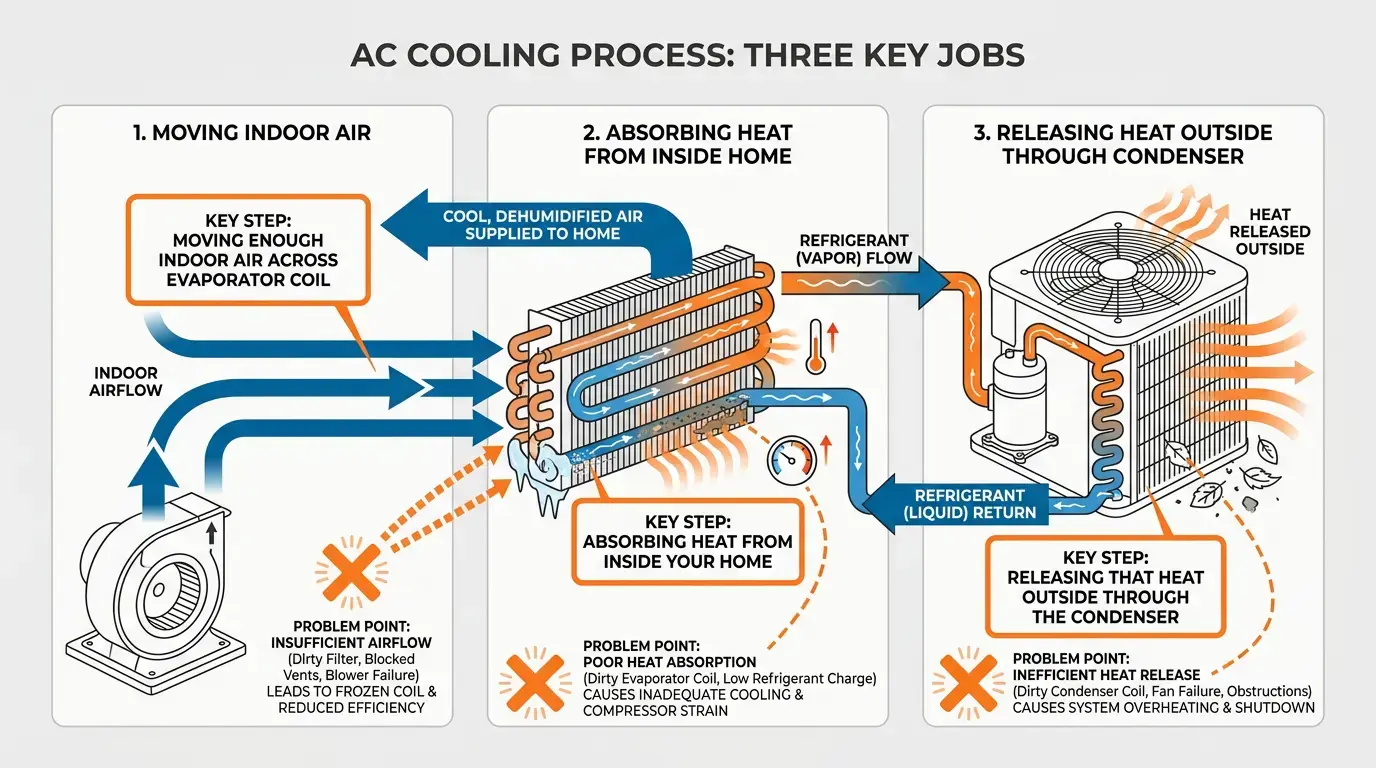
When your AC runs but doesn’t cool, the system is usually failing at one of three jobs:
- Moving enough indoor air across the evaporator coil
- Absorbing heat from inside your home
- Releasing that heat outside through the condenser
That’s why the same symptom, warm air from the vents, can come from several different causes. A clogged filter can block airflow. A refrigerant leak can reduce heat absorption. A dirty condenser can trap heat outside. Leaky ducts can let cooled air escape before it reaches your rooms.
In plain English: Your AC may be making noise, moving air, and looking busy, but one part of the cooling process isn’t doing its job.
Dirty Air Filters Restrict Cooling Airflow
A dirty air filter is one of the easiest problems to miss because it looks too simple to cause this much trouble. Still, it can absolutely make your AC struggle.
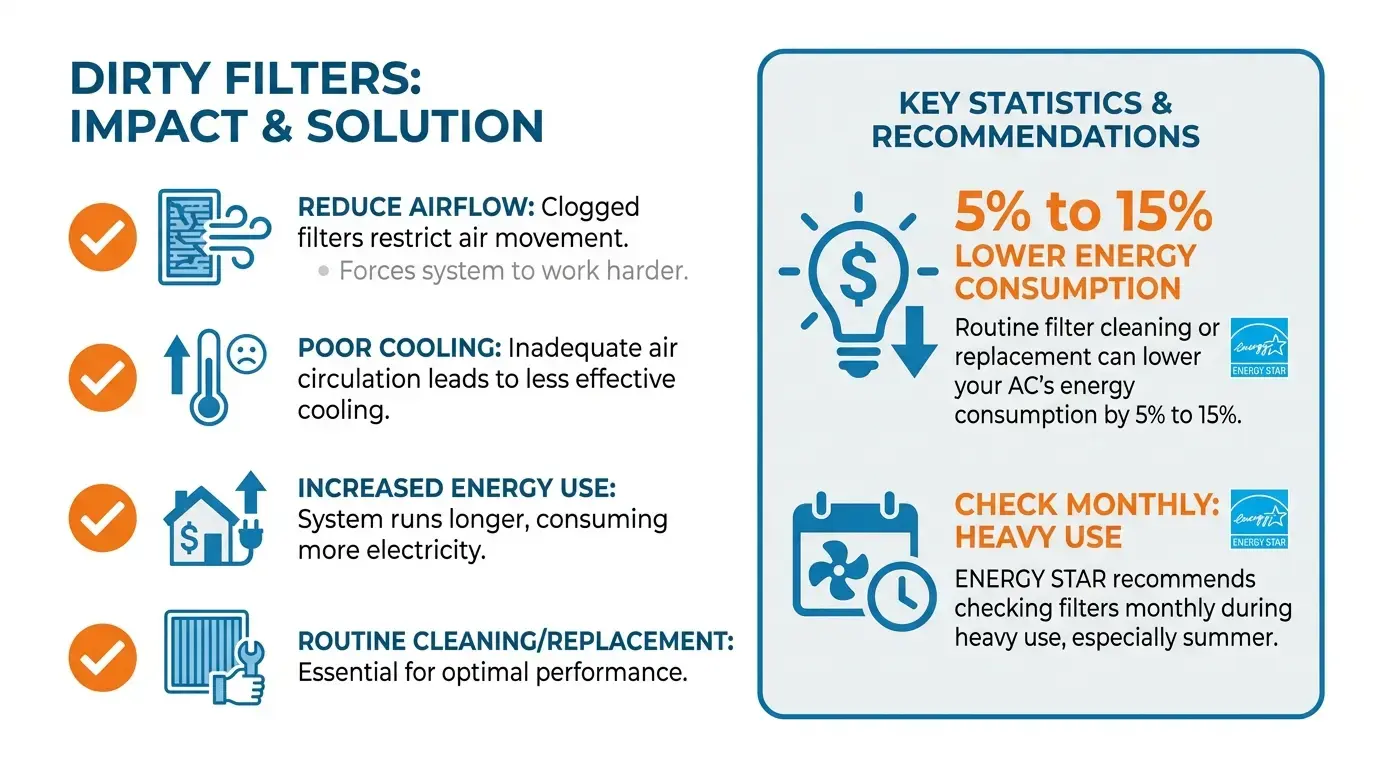
The U.S. Department of Energy says dirty, clogged filters reduce airflow and system efficiency. When airflow is blocked, dirt can also build up on the evaporator coil and reduce its ability to absorb heat. That’s a direct path to weak cooling, longer run times, and frozen coils.
The numbers are worth paying attention to. Routine filter cleaning or replacement can lower your AC’s energy consumption by 5% to 15%.
For Ogden homeowners, that matters most during summer. ENERGY STAR recommends checking filters monthly during heavy use and replacing them when they’re dirty. If you have pets, allergies, recent construction dust, or heavy AC use, your filter may clog faster than the standard timeline, and pet hair can clog it even sooner.
So, if your AC is blowing weak or warm air, start there. It’s cheap, fast, and sometimes enough to get your cooling back. As a rule of thumb, check it monthly and replace dirty filters every 30–90 days for the best airflow.
Incorrect Thermostat Settings Interrupt the Cooling Cycle
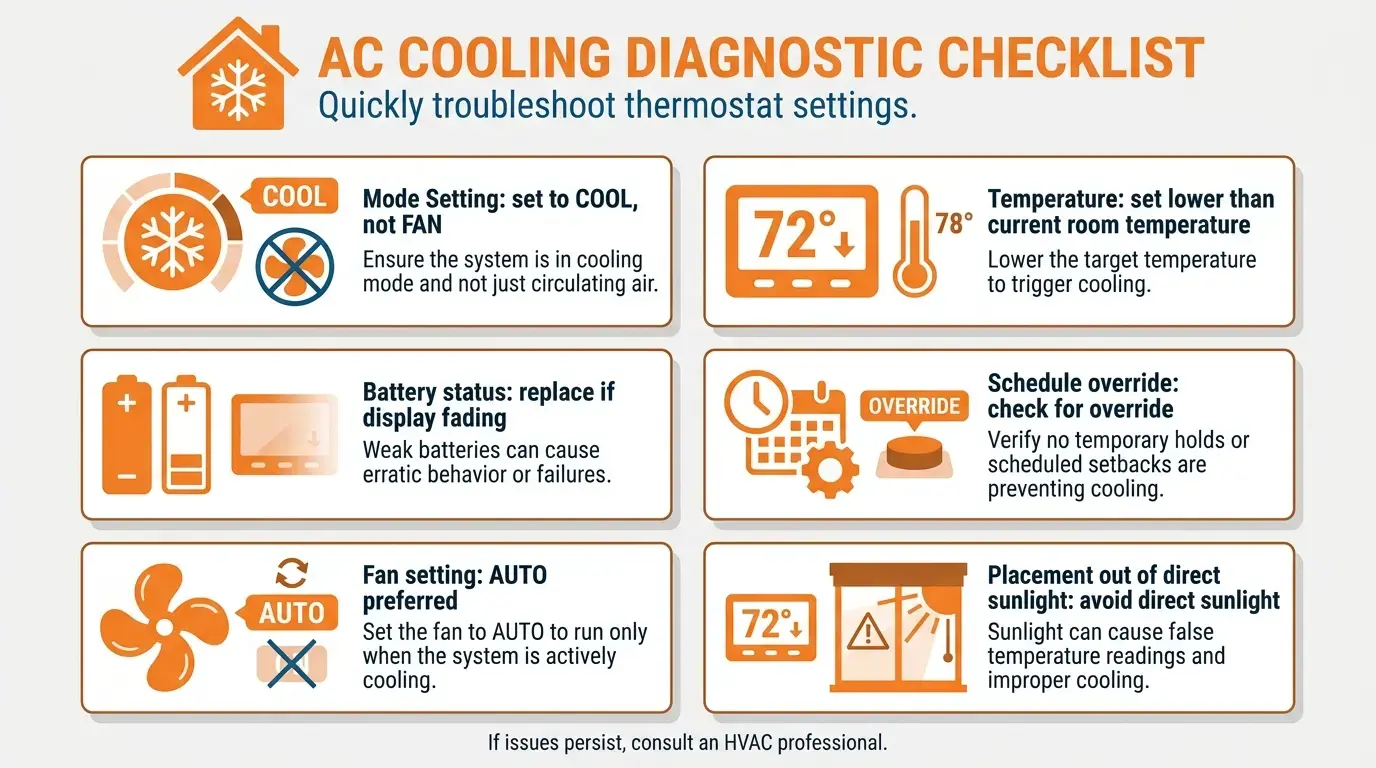
Thermostat issues are sneaky because they don’t feel like real AC problems. But one wrong setting can make your system blow air without cooling it.
Before assuming something expensive has failed, check these:
- Mode: Make sure the thermostat is set to COOL, not FAN.
- Temperature: Set the temperature lower than the current room temperature.
- Batteries: If the display is blank or fading, replace the batteries, because the thermostat may not be signaling the AC to turn on.
- Schedule: Check whether a programmed schedule is overriding your setting.
- Fan setting: AUTO usually makes more sense than ON for normal cooling.
A thermostat can also read the room incorrectly if it sits in direct sunlight.
If the fan is set to ON, it may blow air even when the cooling cycle is not active. That can make it feel like the AC is running but not cooling.
If the settings, batteries, and placement all look fine and the air still feels warm, move on. At that point, a malfunctioning thermostat is less likely to be the main problem.
Dirty Outdoor Condensers Trap Heat Outside
Your outdoor condenser has one big job: Release heat from inside your home.
When the coil on the outdoor condenser unit is covered in dirt, grass clippings, cottonwood fluff, leaves, or debris, heat can’t escape as easily. The system has to work harder, run longer, and cool less effectively.
The Department of Energy recommends keeping outdoor condenser coils clean and making coil cleaning part of routine maintenance, with at least two feet of clearance around the unit. That clearance matters because your condenser needs open airflow to release heat properly.
Ogden’s dry climate can make this worse. Dust, dried grass, and yard debris can collect around outdoor equipment during summer, especially when rain isn’t rinsing the unit regularly.
After shutting power off, you can gently hose visible dirt from the coils with a garden hose. Avoid pressure washing because it can bend the fins. If the condenser still looks clogged or the AC keeps blowing warm air, it’s time for a technician to inspect it, since a blocked outdoor condenser unit can keep the system from cooling properly.
Frozen Evaporator Coils Block Heat Transfer
A frozen evaporator coil sounds strange when your house is hot, but it’s a common reason an AC stops cooling.
Your evaporator coil needs steady airflow to absorb heat. If airflow drops because of a dirty filter, blocked return, blower issue, low refrigerant, or other poor airflow conditions, the coil can get too cold. Moisture freezes on the coil, ice builds up, and the AC loses the ability to cool properly.
The Department of Energy lists dirty filters and coils as maintenance problems that can cause system malfunction and premature compressor or fan failure. That’s why frozen coils should not be ignored.
Watch for these signs:
- Ice on the refrigerant lines
- Poor airflow from the vents
- Warm or barely cool air
- Water around the indoor unit after the ice melts
- AC running for long periods without lowering the temperature
If you see ice, turn the AC off and set the fan to ON to help thaw the coil. Don’t keep running the system while frozen. Once it thaws, check the filter. If the filter is clean or the issue comes back, call an HVAC professional for professional repair.
Comfort Solutions handles AC repair for frozen coils, airflow restrictions, refrigerant leaks, fan motor problems, and electrical component failures. Our certified technicians can diagnose the root cause in the system’s internal components, whether that’s a faulty compressor, low refrigerant, or blower-related issues, instead of only thawing it and sending you back into the same problem next week.
Low Refrigerant Points to a Leak
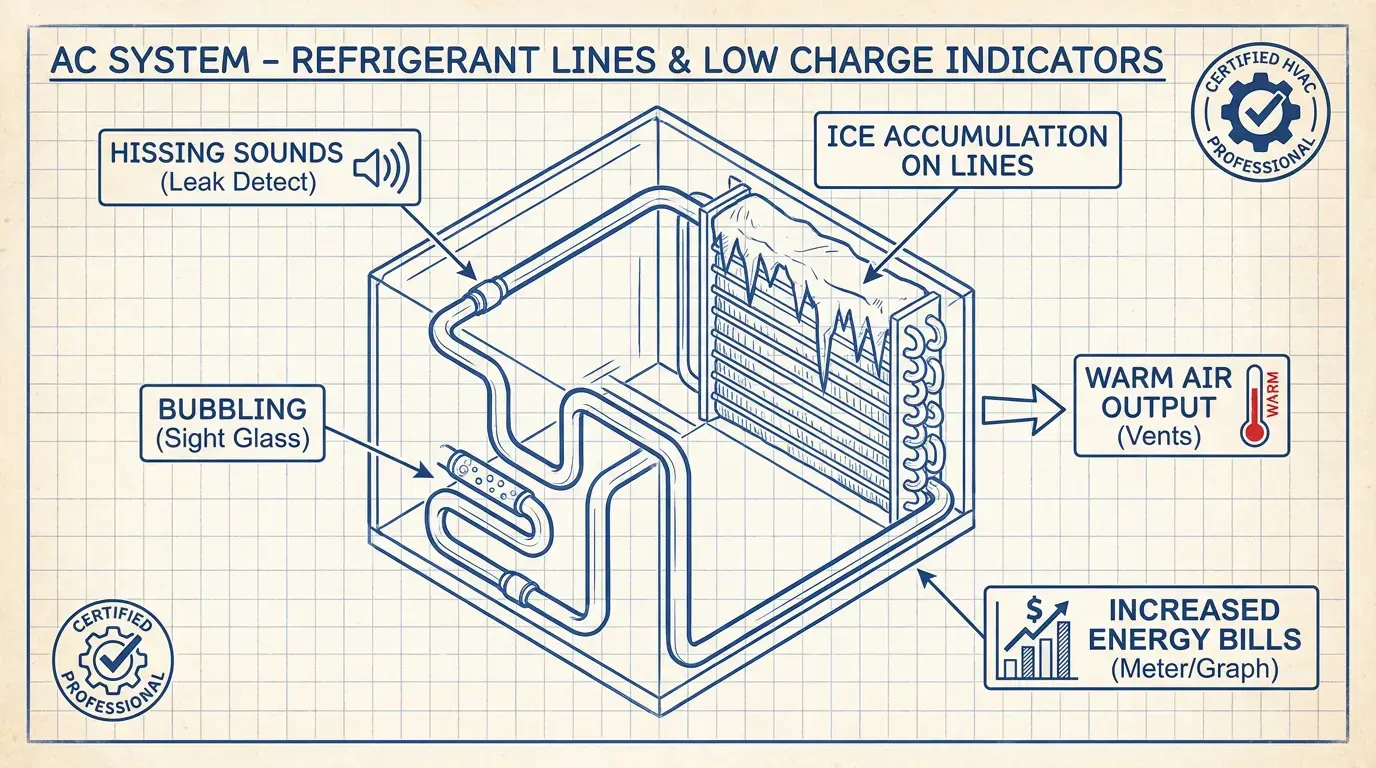
Refrigerant is not fuel. Your AC doesn’t burn through it, use it up, or need a casual top-off every summer.
If the refrigerant is low, there is a leak.
Low refrigerant levels prevent your AC from absorbing and moving heat properly, which keeps it from cooling effectively. That can lead to warm air, frozen coils, longer run times, and compressor damage if the issue is ignored.
Signs of a refrigerant leak include:
- Hissing or bubbling sounds
- Ice on refrigerant lines
- Warm air even while the AC runs, or it may stop blowing cold air
- Higher energy bills
- Longer cooling cycles
- Weak cooling during peak heat
This is not a DIY repair. The EPA requires Section 608 certification for technicians who service equipment that could release refrigerants. The EPA also restricts refrigerant sales to certified technicians.
So, please skip the online recharge kit idea. A certified technician needs to find the leak, inspect the refrigerant line if needed to locate it, repair it, recover or recharge refrigerant correctly, and test the system.
Leaky Ductwork Sends Cool Air Somewhere Else
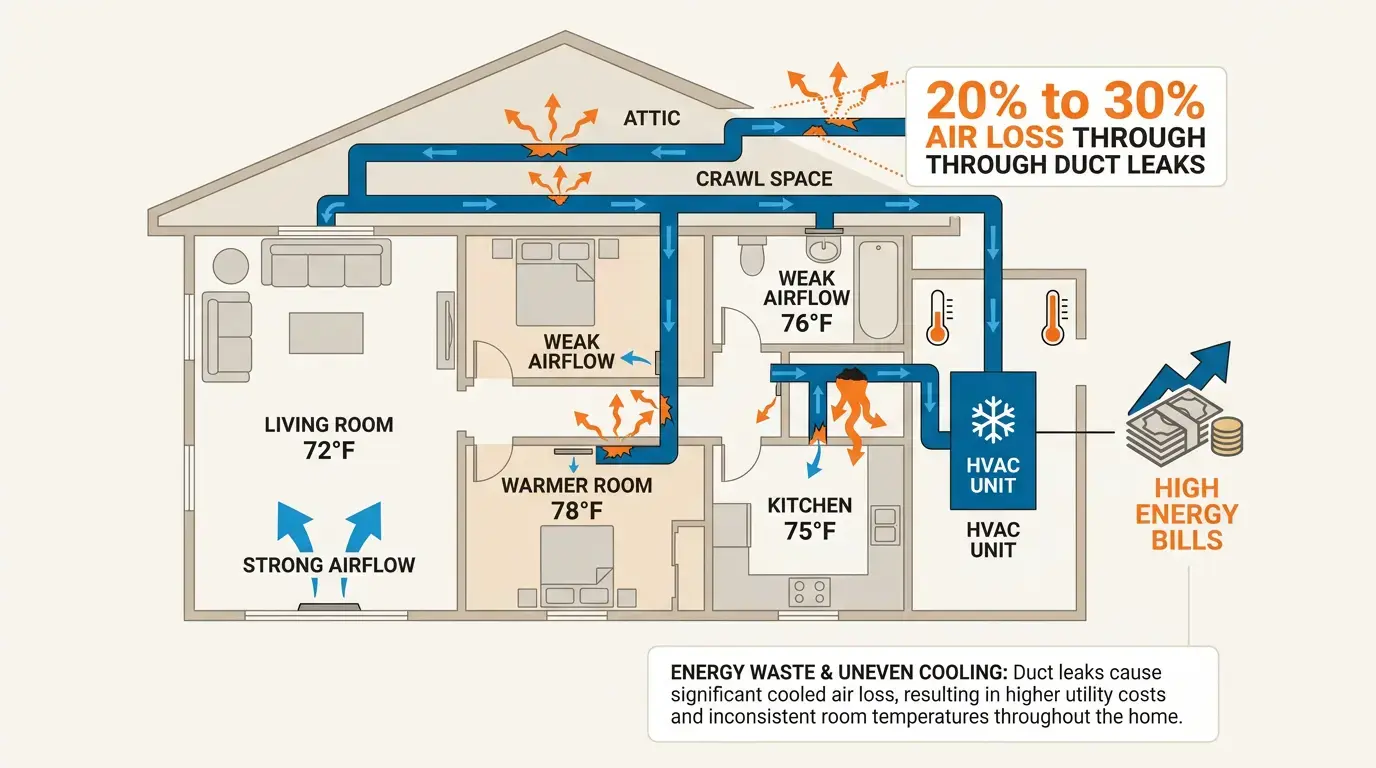
Sometimes the AC is cooling, but the cold air never makes it to the rooms that need it.
That’s a ductwork problem.
ENERGY STAR says a typical house can lose about 20% to 30% of the air moving through the duct system because of leaks, holes, and poorly connected ducts. That means your AC could be doing the work, using the energy, and still leaving bedrooms, upstairs spaces, or far corners of the house warm.
This can be especially frustrating in older Ogden homes where ducts may run through hot attics, basements, crawl spaces, or other unconditioned areas. If those ducts leak, cooled air escapes before it reaches your living space.
Signs of duct issues include:
- One room is much warmer than the others
- Weak airflow from certain vents
- High energy bills
- Dusty rooms even after cleaning
- AC running constantly but comfort still feels uneven
A duct inspection can show whether the issue is the AC itself or the delivery system behind the walls.
Clogged Condensate Drains Can Shut the System Down
Your AC does more than cool the air. It also removes moisture.
That moisture drains through the condensate line. Over time, algae, dust, and debris can clog the line. When water backs up, many systems trigger a safety switch that shuts the unit down to prevent water damage, and clogs can also cause visible water leaks around the indoor unit.
That can make the AC seem like it suddenly stopped cooling for no obvious reason.
Signs of a clogged condensate drain include:
- Water around the indoor unit
- Musty smells near the vents
- AC shuts off unexpectedly
- Thermostat is on, but the system will not complete a cooling cycle
The Department of Energy recommends checking condensate drains as part of AC maintenance. This is a small step, but it can prevent a surprise shutdown when your AC is working hardest.
A simple drain issue can sometimes be fixed quickly. Repeated clogs, though, may point to poor maintenance, drain slope issues, or buildup inside the line.
Electrical Problems Stop Key AC Parts From Starting
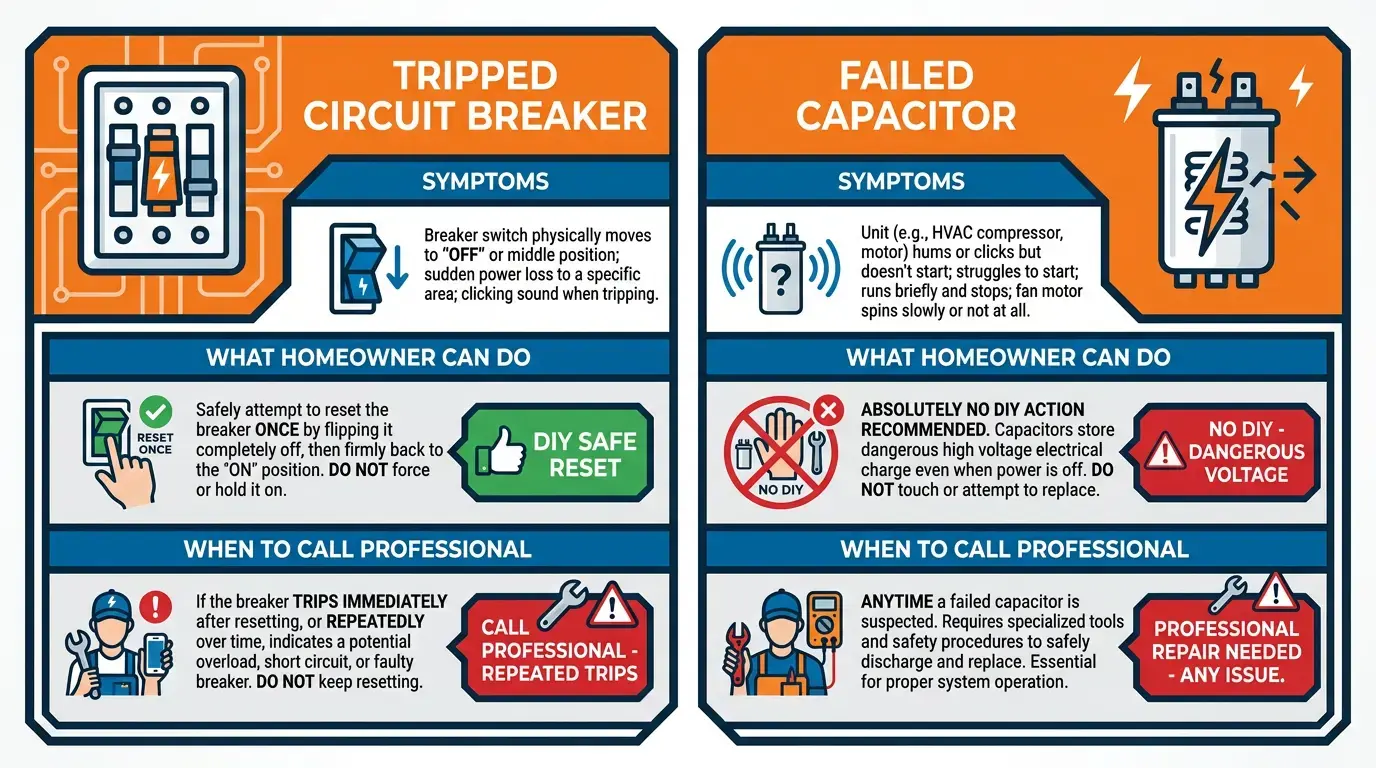
Electrical issues can make your AC act confusing. Sometimes the indoor fan runs, but the outdoor unit does not. Sometimes the unit hums but does not start. Sometimes it starts, shuts off, then tries again.
The common culprits here are a tripped circuit breaker and a failed capacitor.
A tripped breaker is the only one you should try yourself. Check the circuit breaker panel and reset a tripped circuit breaker once. If it trips again, stop there. Repeated tripping can point to a deeper electrical problem.
A capacitor problem is different. The capacitor helps start the compressor and fan motors. When these parts are not working properly, the system may stop blowing cold air. When it weakens or fails, the AC may hum, click, struggle to start, or blow warm air.
Electrical AC repairs involve high-voltage parts, so this is where an HVAC technician should take over and make a safe, proper repair.
Comfort Solutions offers emergency AC repair across Sandy, West Haven, Ogden, Salt Lake City, and nearby Wasatch Front communities. If your AC quits during a hot day, keeps tripping the breaker, or shows signs of electrical failure, we can help you get a technician on the way.
Undersized AC Systems Struggle During Peak Ogden Heat
If your AC has always struggled during the hottest days, the issue may not be a broken part. The system may simply be too small for your home’s square footage.
The U.S. Department of Energy says an undersized unit may have trouble cooling effectively on the hottest days. That matters in Ogden because peak summer heat gives your system very little room to catch up once indoor temperatures climb.
Common signs of an undersized AC include:
- The system runs constantly
- The home never reaches the thermostat setting
- Upstairs rooms stay too warm
- Cooling gets worse during afternoon heat
- The problem happens every summer, not just once
A bigger unit isn’t always the answer, though. The Department of Energy also warns that an oversized unit may not remove humidity properly. NREL also found a typical 9% increase in annual cooling electricity use when units were oversized by 50% or more.
As the largest Trane Comfort Specialist in the Rocky Mountain Region, Comfort Solutions helps homeowners compare repair, replacement, sizing, ductwork, and airflow issues together. If your AC is not cooling because the system is the wrong size or past its useful life, we’ll explain your options clearly before you make a major decision, especially when chronic undersizing leads to frequent repairs before replacement becomes the better choice.
Simple AC Checks to Try Before Calling for Repair
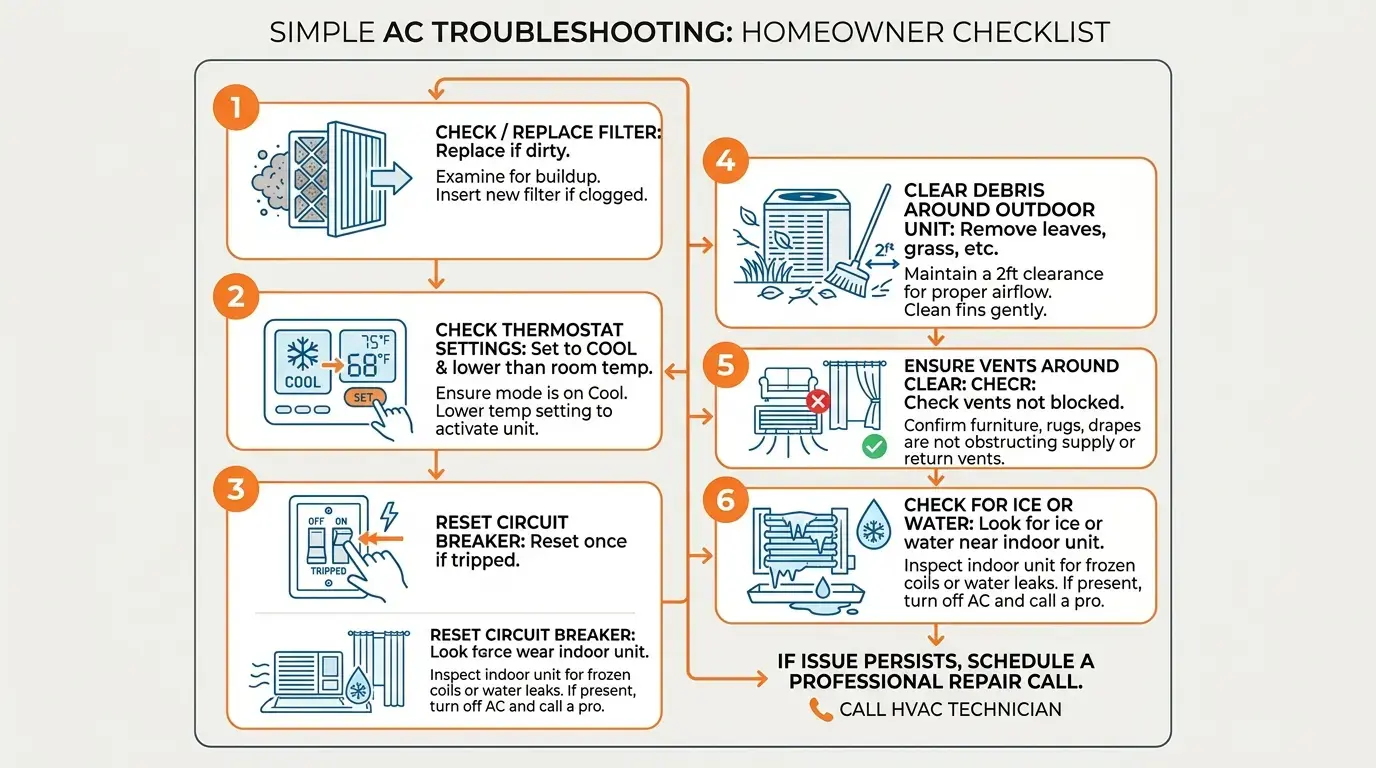
Before you schedule service, there are a few safe checks you can do first when your air conditioner not cooling needs basic troubleshooting.
Start here:
- Check the filter: Replace it if it looks dirty or clogged.
- Check the thermostat: Make sure it is set to COOL and lower than the room temperature.
- Check the breaker: Reset the circuit breaker once if it tripped.
- Check the outdoor unit: Clear leaves, grass, and debris around it.
- Check the vents: Make sure furniture, rugs, or curtains are not blocking airflow.
- Check for ice: Turn the system off if you see frost or ice.
- Check for water: Look near the indoor unit for drain line backup.
After resetting the breaker or thermostat, wait a few minutes before deciding whether the system is blowing cool air again.
If one of those simple checks solves the problem, great. You just saved yourself a service call.
If the AC still does not cool, don’t keep lowering the thermostat and hoping it catches up. That can make the system run longer without fixing the root cause if the simple checks do not work.
Warning Signs That Need Professional AC Repair
Call for AC repair when the easy checks do not solve the problem or when the signs show the system is not working properly and needs professional repair.
You should call an HVAC professional if:
- The AC is not blowing cold air after you check the filter, thermostat, and breaker.
- Ice forms on the refrigerant lines or indoor coil.
- You hear hissing, bubbling, grinding, or loud buzzing.
- The breaker trips more than once.
- The outdoor unit will not start.
- One part of the house stays hot no matter what you do.
- Water is pooling near the indoor unit.
- The AC runs constantly but never reaches the set temperature.
- Airflow problems point to an issue in the air handler as well as the rest of the system.
These are the moments where waiting can make the repair harder. A frozen coil can lead to compressor strain. A refrigerant leak can keep reducing system performance. Repeated breaker trips can signal an electrical issue that should not be ignored.
Comfort Solutions AC Repair for Ogden Cooling Problems
Comfort Solutions provides AC repair services, AC replacement, emergency HVAC service, plumbing, fireplace, and maintenance services for Utah homeowners and property managers.
That matters because cooling problems are not always isolated. Sometimes the issue connects to airflow, ductwork, drainage, electrical components, system age, or whole-home comfort. A room that stays hot may be a duct issue. A system that keeps shutting down may have a drain problem. A unit that runs constantly may need repair, resizing, or replacement.
If your AC isn’t cooling and you want a straight answer, our team can inspect the system, explain what failed, and help you decide whether repair, maintenance, or replacement makes the most sense.
AC Maintenance That Helps Prevent Cooling Issues
Many AC cooling problems start small. A dirty filter. A weak capacitor. A clogged drain line. A condenser that has not been cleaned before peak summer.
Maintenance helps catch those issues before they turn into a no-cooling call on the hottest day of the week, and regular maintenance can help an AC last 15–20 years.
The Department of Energy recommends checking the evaporator coil every year, cleaning the outdoor condenser, clearing debris, and making sure airflow is not blocked. ENERGY STAR also recommends regular professional maintenance to check controls, refrigerant levels, coils, drains, airflow, and even smart thermostat settings or communication issues.
Comfort Solutions offers a Comfort Care Plan for homeowners who want routine support instead of last-minute stress. Members receive benefits like priority scheduling, service discounts, replacement credit, cooling tune-ups, heating tune-ups, and waived dispatch fees when work is performed. If your AC has already given you a scare once, maintenance can help reduce the chance of dealing with the same thing again next summer.
Conclusion
If your AC is not cooling in Ogden, the reason usually comes down to airflow, heat transfer, refrigerant, ductwork, electrical parts, or system sizing. Some fixes are simple, like changing the filter or checking the thermostat. Others need a certified technician, especially refrigerant leaks, frozen coils, repeated breaker trips, and compressor issues.
Comfort Solutions can help you find the real cause, not just guess at it. We’ll inspect the system, explain your options, and help you get your home comfortable again before the heat takes over.
Book Now And Get My AC Cooling Again
FAQs
Why is my AC running but not cooling my house?
Your AC may be running but not blowing cold air because of restricted airflow, frozen coils, low refrigerant, or condenser issues. Start with the filter, thermostat, and breaker. If those check out and the air is still warm, call a technician.
What should I check first when my AC stops cooling?
Check the air filter first, then the thermostat, breaker, outdoor condenser, vents, and signs of ice or water around the indoor unit. These checks are safe for homeowners and can rule out the most basic causes before scheduling AC repair.
Can a dirty air filter really stop my AC from cooling?
Yes. A dirty air filter restricts airflow, which makes it harder for the system to absorb heat and move cooled air through your home. It can also contribute to frozen evaporator coils if ignored.
Why is my AC blowing warm air after I changed the filter?
If the filter was not the only issue, the system may have frozen coils, low refrigerant, a dirty condenser, duct leakage, or an electrical problem. Turn the system off if you see ice, and call a technician if warm air continues.
Is low refrigerant something I can fix myself?
No. Low refrigerant means there is a leak, and refrigerant handling requires EPA Section 608 certification. A certified technician needs to locate the leak, repair it, and recharge the system properly.
Why are some rooms hotter than others when the AC is on?
Uneven cooling can come from leaky ducts, blocked vents, poor insulation, an undersized AC, or airflow imbalance, and when some rooms stay hotter, the AC may be cooling the air inside the system but losing airflow or conditioned air before it reaches the room. ENERGY STAR says duct leaks can waste 20% to 30% of the air moving through the duct system, so the problem may be in the ductwork rather than the AC unit.
Can an AC be too small for my home?
Yes. An undersized AC may run constantly and still fail to reach the thermostat setting during hot Ogden afternoons. A technician can perform a load calculation to determine whether the system is properly sized for your home.
When should I call for emergency AC repair?
Call for emergency AC repair if the system stops cooling during extreme heat, the breaker keeps tripping, you smell burning, you hear loud electrical buzzing, or vulnerable people in the home need cooling restored quickly.
How often should I change my AC filter in summer?
Check your filter every month during heavy-use seasons like summer. Replace it when it looks dirty, and do not go longer than three months between changes under normal use.
Recent News

Furnace Tune-Up Cost in Sandy, UT: What Homeowners Need to Know
September 28, 2026

How Much Does It Cost to Replace a Furnace in Sandy, Utah: A Homeowner’s Guide
September 23, 2026

How Long Do Furnaces Last for Salt Lake City Residents? A Guide to Warning Signs and Replacement Timing
September 7, 2026
How to Improve Indoor Air Quality During Utah’s Wildfire Season
August 28, 2026
AC Stopped Working in Ogden? Common Causes and What to Do Next
August 24, 2026
HVAC Maintenance Services in West Haven, Utah: Fall Checklist for Homeowners
August 19, 2026