Serving The Wasatch Front Area



Back to Blog
AC Installation Cost in Ogden, Utah: What Homeowners Can Expect to Pay in 2026
August 11, 2026
A new air conditioner is one of the larger home-comfort investments you’ll make, and the uncertainty around price can be frustrating. Ogden homeowners deserve to know what drives the quote before a contractor starts the work.
Equipment is only part of the total. Home size, cooling load, efficiency, ductwork condition, electrical capacity, permits, and installation complexity all affect what you’ll pay.
National averages can provide context, but they don’t account for your home’s condition or Northern Utah’s installation requirements.
Below, we’ll break down realistic planning ranges, explain the costs that can change a quote, and show you how to compare estimates without getting buried in HVAC jargon.
Key Takeaways
- Standard Ogden installations are commonly estimated at $3,800 to $7,500; complex projects can exceed $12,000.
- A Manual J load calculation is more reliable than square footage or the old unit’s size alone.
- Duct, electrical, permit, and line-set costs should be itemized in the written estimate.
- The federal Section 25C credit ended after 2025, but current utility programs or contractor offers may still apply.
How Much Does AC Installation Cost in Ogden, Utah?
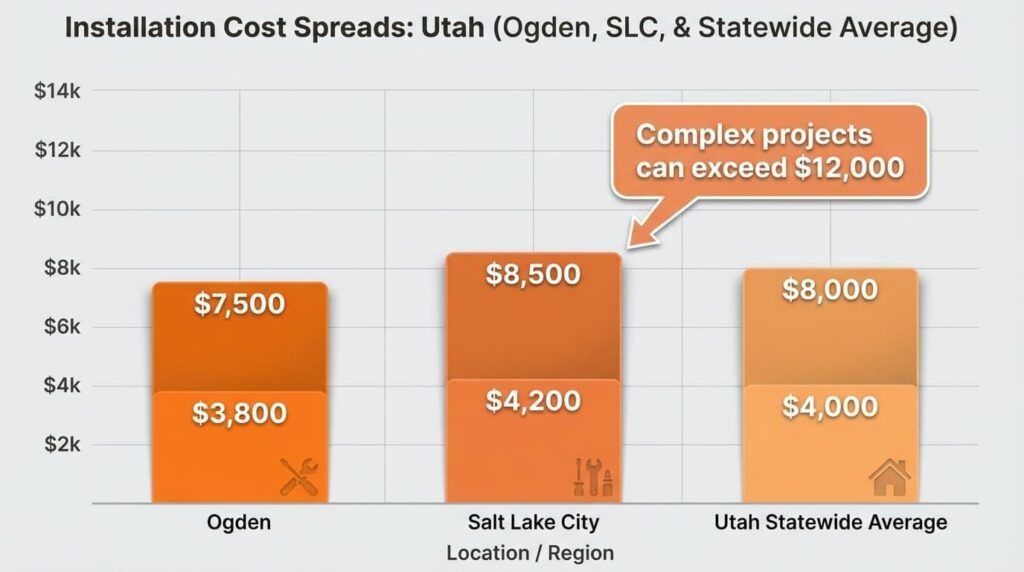
For budgeting purposes, central AC installation in Ogden is commonly estimated at $3,800 to $7,500, based on local cost data for Ogden installations. That range generally assumes a standard installation with usable ductwork. New ducts, electrical upgrades, difficult access, or higher-efficiency equipment can push a project beyond $12,000, as reflected in broader Utah HVAC replacement estimates. Treat these figures as planning benchmarks, not a substitute for an in-home assessment and written quote.
What a Standard Ogden Installation Price Usually Covers
A quote near the typical range usually covers a properly sized 2- to 4-ton central air conditioner, standard labor, connection to serviceable ductwork, startup testing, basic installation materials, and a standard replacement job that usually takes 6 to 8 hours. Ask the contractor to state exactly what’s included because equipment, permit, disposal, and warranty terms can differ, and that timing assumes a straightforward replacement rather than extra site work.
Smaller, straightforward homes may fall near the lower end. Larger homes, homes with comfort zones, and properties with restricted equipment access often cost more because they require more capacity, controls, materials, or labor.
Higher-efficiency SEER2 equipment usually costs more upfront and may lower cooling energy use when the system is sized and installed correctly. Duct modifications can add substantially to the project, which is why the factors behind an AC installation quote matter more than the equipment price alone.
Why Nearby Installation Prices Aren’t Always Comparable
A lower advertised price in another city doesn’t necessarily mean the same project costs less there. Labor scope, permit handling, equipment model, warranty coverage, ductwork, electrical work, and disposal can all differ between quotes.
| Location | Typical Installation Range |
|---|---|
| Ogden | $3,800 to $7,500 |
| Salt Lake City | $4,200 to $8,500 |
| Utah Statewide Average | $4,000 to $8,000 |
Use price ranges to set a budget, then rely on an assessment of your actual home. Comfort Solutions’ AC installation process for Ogden homes includes evaluating the layout, cooling demand, and existing system before recommending equipment, so you’re comparing a real scope of work rather than a generic number in Ogden, UT.
Which Air Conditioning System Is Right for Your Ogden Home?
Not every home in Ogden needs the same type of cooling system. The best option depends on your home’s layout, whether you already have ductwork, how many rooms you want to cool, and your overall budget. Here’s how the most common air conditioning systems compare.
| System Type | Typical Installed Cost | Best-Fit Scenario |
| Central AC | $3,800 to $7,500 | Whole-home cooling with existing ductwork |
| Mini-Split (single zone) | $1,500 to $4,500 | Additions, older homes, no ductwork |
| Mini-Split (multi-zone) | $5,000 to $10,000+ | Multiple rooms without ductwork |
| Window Unit | $150 to $700 per unit | Single-room cooling, no installation labor |
The system-level ranges shown above align with residential air-conditioning cost benchmarks for Utah, but your quote should still reflect your layout, ductwork, electrical service, and comfort priorities.
Central Air Conditioning
Central air conditioning is the best option for homeowners who want consistent cooling throughout the entire house. If your home already has ductwork in good condition, it usually delivers the best balance of comfort, efficiency, and long-term value for your home’s cooling. If the ducts need repairs or replacement, however, installation costs can increase. Central AC replacement services may also include air conditioning replacement choices based on the home’s layout and available space.
Mini-Split Systems
Mini-split systems are ideal for homes without existing ductwork, room additions, finished basements, or garages. For some homes, a heat pump may be a better fit if you want efficient cooling and heating from one system. Because each indoor unit operates independently, you can cool only the rooms you’re using, improving comfort while reducing energy consumption.
Window Air Conditioners
Window air conditioners work well for cooling individual rooms and have the lowest upfront cost. They’re often a practical choice for renters or homeowners looking for a temporary solution, but they generally provide lower efficiency, more operating noise, and less even cooling than permanent systems.
How Home Size and AC System Size Affect Installation Costs
Home size influences cooling demand and installation cost, but square footage alone cannot determine the correct capacity. Insulation, air leakage, window area, ceiling height, orientation, occupancy, and sun exposure can change the load significantly.
Use the table below only as an early planning reference. These Utah HVAC costs by home size provide additional context, but a load calculation should decide the equipment size.
| System Size | Approximate Home Size | Typical Installed Cost (Ogden) |
| 1.5 Ton | Up to 900 sq ft | $3,800 to $4,500 |
| 2 Ton | 900 to 1,200 sq ft | $4,000 to $5,000 |
| 2.5 Ton | 1,200 to 1,500 sq ft | $4,500 to $5,500 |
| 3 Ton | 1,500 to 2,000 sq ft | $5,000 to $6,000 |
| 4 Ton | 2,000 to 2,500 sq ft | $5,500 to $7,000 |
| 5 Ton | 2,500 to 3,000 sq ft | $6,500 to $8,500 |
Proper AC Sizing Starts With a Manual J Load Calculation
A Manual J load calculation is the industry standard for determining the right air conditioner for your home. Proper sizing starts with a proper load calculation performed by trained technicians. Rather than relying on square footage alone, it considers insulation levels, window area, ceiling height, sun exposure, occupancy, and Ogden’s local climate. At 4,341 feet above sea level, Ogden’s elevation can also affect AC performance and setup.
Two homes with the same floor plan can need different capacities because construction, orientation, shading, and air leakage differ. Skipping the load calculation is one of the air-conditioner mistakes that can undermine comfort because it can lead to sizing errors that reduce comfort, raise energy use, and increase equipment wear.
Why an Oversized Air Conditioner Can Create More Problems
Bigger isn’t always better when it comes to air conditioning. An oversized system can cool the home too quickly, causing it to shut off before completing a full cooling cycle. This short cycling increases wear on the compressor, raises energy bills, and leaves your home feeling less comfortable because it doesn’t remove enough humidity. An undersized system can create the opposite problem by running constantly and still struggling to maintain the set temperature.
If you’re dealing with uneven temperatures or an AC that isn’t cooling properly, incorrect sizing may be one cause, but it isn’t the only possibility. A technician should also test airflow, refrigerant charge, controls, duct leakage, and equipment condition before recommending replacement.
Hidden Costs That Can Increase Your AC Installation Price
A preliminary quote can change when the installer uncovers damaged ducts, inadequate electrical service, or other site conditions. A thorough pre-installation assessment helps surface those costs before the work begins.
Ductwork Repairs Can Add Thousands
Ductwork is one of the most common hidden expenses during an AC installation, and ductwork modifications are a frequent added scope item alongside repairs. If your ducts are leaking, undersized, or damaged, your new system won’t perform as efficiently as it should.
Common additional costs include:
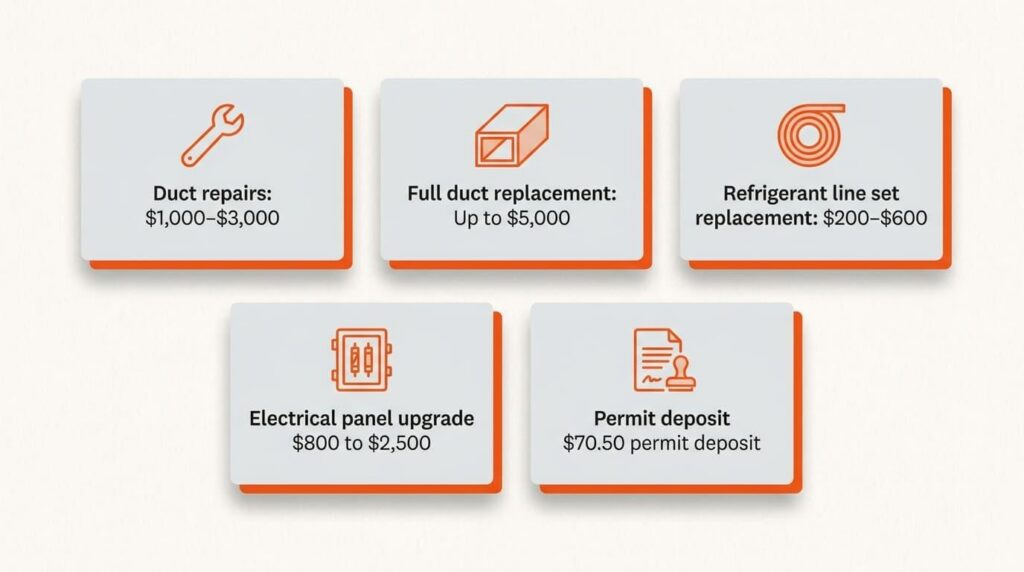
- Duct repairs: $1,000–$3,000
- Full duct replacement: Up to $5,000
- Refrigerant line set replacement: $200–$600
- Equipment pad or mounting upgrades: $200–$600
These changes can extend installation time to 1.5 to 2 days and raise labor costs.
Leaking, restricted, or poorly insulated ducts can contribute to frozen AC coils and poor cooling performance, so installing new equipment without addressing the airflow problem can leave you disappointed with the result.
Your Electrical Panel May Need an Upgrade
Some older Ogden homes may not have the circuit capacity or disconnect configuration required by the selected equipment. If the existing electrical setup can’t safely support the system, the necessary work must be completed before installation.
A panel or related electrical upgrade is sometimes budgeted at $800 to $2,500, but the actual scope can vary widely. Ask the HVAC contractor and a qualified electrician to identify the exact work instead of treating this range as a guaranteed price.
Permits Are Part of the Total Cost
Ogden City requires a permit when a mechanical system is installed, altered, repaired, or replaced. The city’s residential permit application information lists a $70.50 deposit at application acceptance, which is applied to the final permit price; the total fee depends on the project.
Permit and inspection costs should appear in the written estimate, not emerge after work begins. They are commonly included in Utah HVAC cost estimates by service type, but confirm who will obtain the permit, schedule inspection, and pay the final fee.
Repair or Replace Your AC? Here’s How to Decide
When repairs become frequent or expensive, it’s reasonable to ask whether another fix is buying useful life or only delaying replacement. Start with the system’s condition, repair history, efficiency, comfort performance, and the cost of the proposed work. If the current system is outdated, inefficient, or needs frequent repairs, a new installation may make more sense.
Use the $5,000 Rule as a Conversation Starter
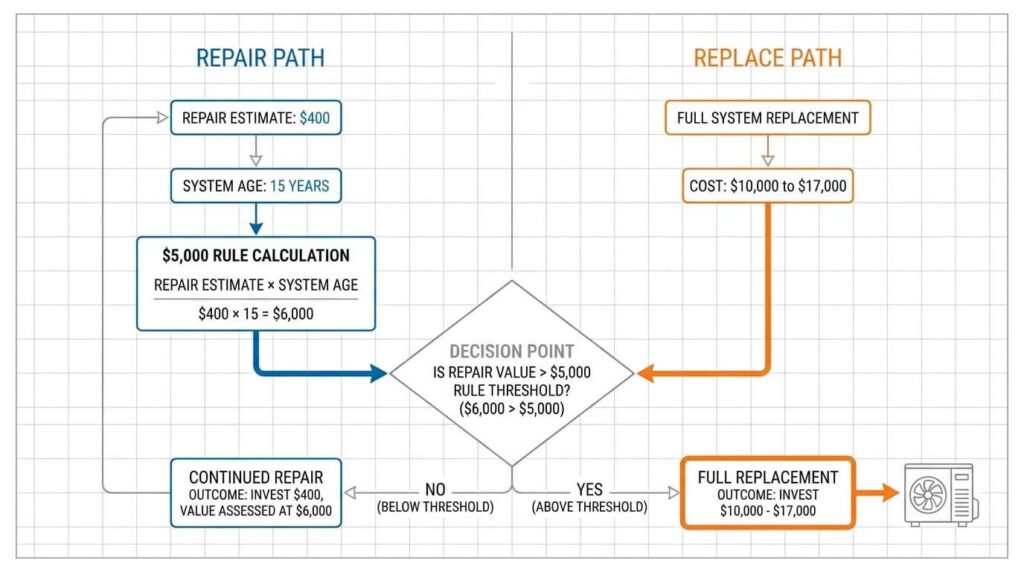
The $5,000 rule is a rough industry shortcut, not a technical standard: multiply the repair estimate by the system’s age. A result above $5,000 suggests that replacement deserves serious consideration, but it shouldn’t make the decision for you.
A $400 repair on a 15-year-old unit equals $6,000 under that formula. Before replacing it, ask a technician to confirm the diagnosis, expected remaining life, warranty status, and whether the repair addresses the root cause. Those factors make an AC repair-versus-replacement cost comparison more useful than the formula alone.
Older Systems Usually Cost More Than They’re Worth
Once an air conditioner reaches 15 to 20 years old, major repairs become much harder to justify. That’s especially true if the system has already needed multiple service calls.
Older units often become expensive to own because:
- Some older systems use R-22 refrigerant. U.S. production and import ended in 2020, so servicing relies on reclaimed or previously produced supply.
- They lose efficiency over time, leading to higher monthly energy bills.
- Replacement parts become harder to find as manufacturers discontinue older equipment.
If the AC and furnace are both near the end of their service life, a full system replacement typically runs between $10,000 and $17,000.
If you’re repeatedly troubleshooting the same AC cooling problem, ask for the cumulative repair total and a replacement estimate side by side. Recurring failures can make replacement more economical, even when each individual repair seems manageable.
Ways to Lower the Cost of a New AC System
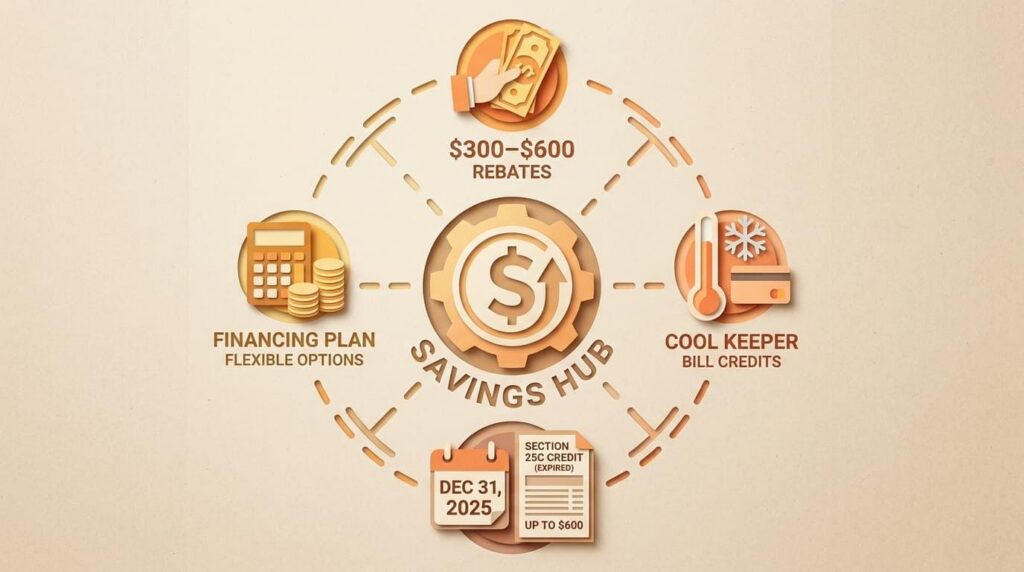
Your final out-of-pocket cost may be lower than the quoted price if a current utility program, manufacturer promotion, contractor offer, or financing plan with flexible payment options applies. Eligibility and terms change, so verify them before choosing equipment. Some high-efficiency systems may qualify for rebates of $300–$600, depending on current program rules.
Verify Current Rocky Mountain Power Programs
Rocky Mountain Power’s residential offerings change over time and may depend on the equipment, property type, and program rules. Its current home energy-saving programs and rebates should be checked before you assume a central AC purchase qualifies. Utah customers with eligible central air conditioning may also receive annual bill credits through Cool Keeper, which is a demand-response program rather than an installation rebate.
Efficiency can lower cooling energy use, but savings depend on weather, thermostat settings, utility rates, duct condition, and correct installation. These Utah HVAC pricing factors can help frame the tradeoff, while the current program administrator should confirm any incentive.
Don’t Budget for an Expired Federal AC Credit
The federal Section 25C Energy Efficient Home Improvement Credit is not available for central air conditioners placed in service after December 31, 2025. The IRS confirms the credit’s termination date, so a system installed in 2026 does not qualify for the former credit of up to $600.
That change makes current utility programs, manufacturer incentives, financing, and contractor offers more important to evaluate. The benefits of upgrading an AC system can still include more consistent comfort, better reliability, and lower energy use, but the decision should work financially without counting an expired tax credit.
How to Compare AC Installation Quotes in Ogden
Two or three detailed quotes can reveal major differences in equipment, scope, warranty, and contractor assumptions. Compare like with like; the lowest total is not a bargain if it omits sizing, permits, duct corrections, or startup testing.
What Every AC Installation Quote Should Include
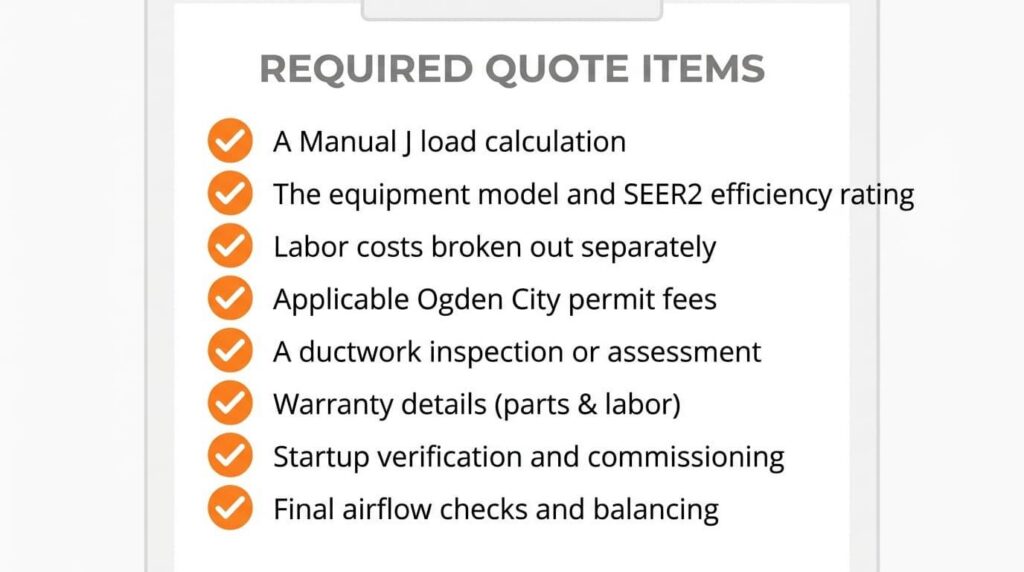
A detailed estimate should clearly outline everything that’s included in the project. Before comparing prices, make sure each quote covers:
- A Manual J load calculation
- The equipment model and SEER2 efficiency rating
- Labor costs broken out separately
- Applicable Ogden City permit fees
- A ductwork inspection or assessment
- Warranty details so you can compare the best warranties, not just equipment price
- Startup verification, including refrigerant charge, controls, and electrical connections
- Final airflow checks
Don’t focus on price alone. A lower quote that leaves out permit fees or skips proper system sizing can end up costing far more after installation begins. No-pressure recommendations and clear scope details also make quotes easier to compare fairly.
Compare the scope first and the total price second. Before signing, use Utah’s Construction Business Registry to check the HVAC contractor classification and available license information.
Schedule Your Installation During the Off-Season
If your system is still operating safely, planning before the first hot spell gives you more time to evaluate equipment and scheduling. Spring and fall often offer more appointment flexibility than peak summer, although availability and promotional pricing vary by contractor.
Your Next Step Toward a Cooler Ogden Home
A new air conditioner is a significant investment, but the decision becomes clearer when the quote explains sizing, equipment, ducts, electrical work, permits, labor, and warranty coverage in plain language.
Comfort Solutions has served Utah since 2000 and has grown to more than 100 employees across Weber County, Davis, Cache, Box Elder, Summit, and Salt Lake counties. As the Rocky Mountain region’s largest Trane Comfort Specialist, we bring local experience to the sizing, equipment selection, and installation details that determine how a system performs after the quote is signed, including conditions common along the Wasatch Front.
If you’re ready to replace your air conditioner, or you simply want a clear assessment of your options, we’ll help you choose a system that fits your home, comfort priorities, and budget with quality installation and without overselling what you don’t need.
Frequently Asked Questions About AC Installation in Ogden
These answers cover the cost, timing, and replacement questions Ogden homeowners ask most often before requesting an estimate.
What is the $5,000 rule for HVAC?
The $5,000 rule is a quick screening tool: multiply the repair estimate by the unit’s age. A result above $5,000 suggests replacement is worth comparing, but the system’s condition, warranty, repair history, and remaining life should guide the final decision.
How much does it cost to install AC in a 2,000-square-foot house?
A 2,000-square-foot Ogden home may fall around $5,000 to $7,000 for a straightforward central AC installation, but square footage cannot produce an exact quote. Capacity, ductwork, electrical service, access, efficiency, permits, and equipment selection can move the price substantially.
Will HVAC prices go down in 2026?
No one can reliably promise that HVAC prices will fall in 2026. Equipment, refrigerant, labor, tariffs, and supply conditions can change, so base the timing on system reliability, safety, comfort, and a current written quote rather than a price forecast.
Is it worth repairing a 20-year-old AC unit?
A 20-year-old unit can sometimes be repaired, but major work is often difficult to justify when efficiency, parts availability, refrigerant type, and recurring failures are considered. Ask for the repair cost, expected remaining life, and replacement options before deciding.
Is there a federal tax credit for a new air conditioner in 2026?
No. The federal Section 25C credit is not available for central air conditioners placed in service after December 31, 2025. Check current utility, manufacturer, and contractor programs instead, and confirm eligibility before including any incentive in your budget.
What is the best time of year to replace an air conditioner?
Spring and fall often provide more scheduling flexibility in Ogden, but the best time is before an unreliable system fails during peak heat. If replacement is already likely, planning early gives you more time to compare equipment, scope, and financing, and some homeowners replace sooner for reliability, lower utility bills, and peak-heat concerns.
Recent News

How Much Does It Cost to Replace a Furnace in Sandy, Utah: A Homeowner’s Guide
September 23, 2026
How Long Do Furnaces Last for Salt Lake City Residents? A Guide to Warning Signs and Replacement Timing
September 7, 2026
How to Improve Indoor Air Quality During Utah’s Wildfire Season
August 28, 2026
AC Stopped Working in Ogden? Common Causes and What to Do Next
August 24, 2026
HVAC Maintenance Services in West Haven, Utah: Fall Checklist for Homeowners
August 19, 2026
Best AC for Ogden Home: The Homeowner’s Guide to Choosing the Right AC System
August 14, 2026